

You’ve been walking when the weather cooperates, squeezing in workouts when you can and wondering why the stairs still feel like such a climb. Then the temperature drops, it’s dark by dinner - and the routine you were counting on gets even harder to keep.
Sound familiar? You go all in for two weeks and burn out. You change exercises so often that you can’t tell what’s improving. Or you finish every workout exhausted and spend the next few days avoiding the stairs.
Let’s put those insights to work for winter, with additions from Bill to build strength, mobility and balance.
1. Build a routine you can keep when the weather turns
A five-day plan can sound great when you’re feeling motivated. What will you actually do in a week when it snows, work runs late, the sun sets at 5 PM - and you’ve already changed into your slippers by six?
Put two strength sessions in your calendar and give each one a backup. For example, plan a Tuesday home workout and a Saturday session. If Tuesday gets away from you, move it to Wednesday morning. If the roads are bad on Saturday, use a home routine or arrange a Zoom workout. Having the backup decided ahead of time saves you from having to make a fresh plan when you’re tired.
Give your walks the same treatment. If darkness keeps cutting your evening walk short, try going at lunch. On icy days, put on two favourite songs and walk indoors. If it’s the company you miss, make a date with your walking partner somewhere indoors.
2. Keep a few exercises long enough to get better at them
Repeating an exercise gives you a chance to practice it and see what’s changing.
Say you start with five sit-to-stands from a sturdy chair, using the armrests as needed. Over time, you might sit down with more control or use a little less help from your hands. When five feels comfortable, try six. With a dumbbell exercise, you might add a little weight once your usual repetitions feel steady.
Write down three things after a session. The exercise, how many repetitions you did and how it felt. Increasing the challenge a little at a time is called progressive overload. Keep the changes small enough that you can still move well and tell what’s improving.
3. Keep the cardio you enjoy and give strength its own spot
Walking, cycling or dancing in the kitchen can all be part of a winter routine. Strength training deserves its own spot on the calendar, especially if your goals include carrying groceries, getting out of a low chair or feeling steadier on stairs. Canadian movement guidelines call for muscle-strengthening activities at least twice a week for adults and include balance activities for adults 65 and older. See the Canadian 24-Hour Movement Guidelines.
Here’s where Bill likes to start, from the feet up. Before you stand from a chair, notice how both feet make contact with the floor. Breathe out as you stand, then take your time sitting back down. At a sturdy counter, try a few slow heel raises. Pay attention to how evenly you rise and how much hand support you need. Those details give us somewhere to start when we work on stability, mobility and strength. Read more about Bill’s approach to whole body fitness.
4. Choose a handful of exercises and give them your attention
Extra sets and exercises can pile on fatigue without doing much for the goal you came in with. A burning sensation during a long set tells you how the set feels. To judge the challenge, ask yourself how many more repetitions you could do with the same control. Could you do 2 more reps with control? Try adding small increments or a slight increase in your weights.
Go into your workout with a short list. On a busy day, that could be sit-to-stands, wall push-ups and supported heel raises. Give yourself time to catch your breath and start the next set when you feel ready to move well again. If the last few repetitions feel like work and you can still control them, you’ve found a useful starting point. If you’re rushing or holding your breath to finish, make the next set a little easier.
5. Let one workout set you up for the next
There’s a difference between feeling pleasantly tired after a session and being so wiped out that you put off the next one. If that keeps happening, look at how much you’re doing in a single session and how close together your harder days are.
Try strength on Tuesday and Friday, with easier movement between them. Take a comfortable walk, do some gentle mobility work or stand up and move around after a long stretch at the computer. If you’re returning after a break, spend the first few sessions getting familiar with the movements and seeing how you feel the following day. Then build from there.
6. Look at what you eat and drink on an ordinary day
It’s easy to remember what you had for dinner and overlook the sweetened coffees or evening drinks that have quietly become part of the week.
Look at a few ordinary days before changing anything. Are you missing lunch and arriving at dinner ravenously? Would having a protein snack or meal ready after a workout help? Are there drinks you order out of habit that you’d happily have less often? Start with one change you can live with. That might mean keeping eggs and salmon ready for training days or ordering a smaller version of the coffee you enjoy.
7. Keep a short version of your workout for busy days
When you’ve got ten minutes before dinner, it helps to know what you can do with them. Set up a sturdy chair and clear a little space by the wall or counter. Try one round at a comfortable pace, with breaks as needed.
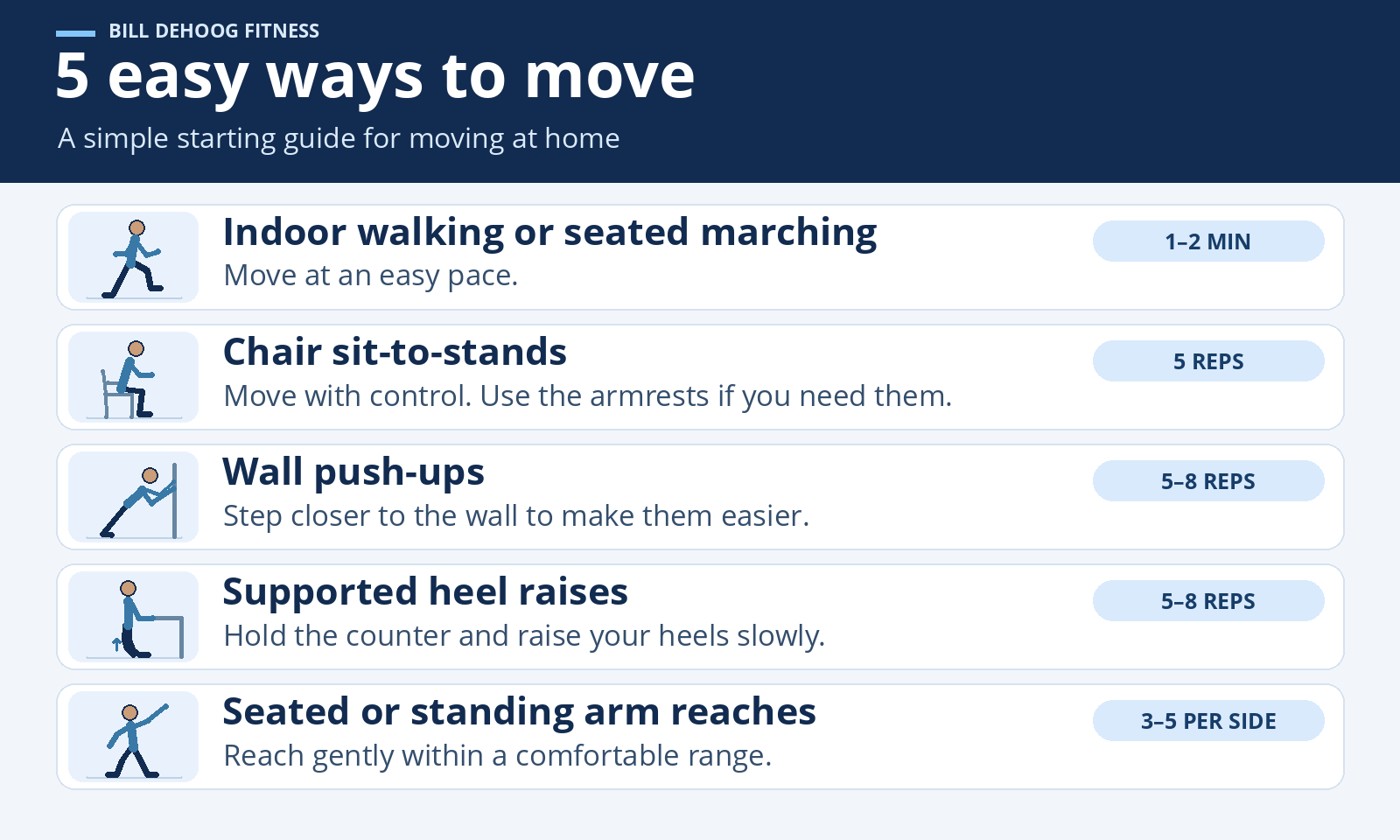
You can also tuck a single movement into something you already do. Try a few supported heel raises while the kettle boils, take a lap around the house during a long call or stand up and move around between episodes. Pick one cue you’ll remember and give it a week.
8. Measure something you actually care about
Fitness feeds can make it look like everyone else is progressing faster. Your own week gives you a more relevant comparison. Can you carry the groceries in with fewer stops? Get out of your favourite chair with less difficulty? Walk the same route and feel more comfortable at the end?
Pick one everyday task and check in on it every few weeks. In between, give yourself something to look forward to. Save a favourite podcast for your indoor walk, put a workout date in the calendar with a friend or keep a simple tally of the sessions you made time for. Include the short ones. It’s easier to stay interested when you can see what you’re getting better at and enjoy some of the time you spend doing it.
9. Use Zoom workouts to take the commute out of the equation
If the hardest part of exercising in winter is getting out the door, an online workout via Zoom gives you a way to train from home. Set up your space a few minutes early, have a sturdy chair or any equipment you’ll be using nearby and give the session a regular spot in your week.
If you’re looking for a personal trainer in Brantford or want to ask about Zoom workouts from home, Bill offers a free fitness assessment through Bill DeHoog Whole Body Fitness.
We’ll talk about your current fitness level, any restrictions and what you’d like to do more comfortably. Then we can build a plan around your goals, whether that means getting stronger, improving mobility and balance or finding a winter routine you can keep. Get in touch about a free fitness assessment or Zoom workouts.