
Could Bread Be Behind Your Cravings and Energy Crashes?

You’ve heard the advice - and likely tried it all before:
Cut sugar.
Ditch the snacks.
Skip dessert.
Be more disciplined.
So you do. You say no to sweets. You make the “right” choices.
And yet…nothing really changes.
The cravings are still there. The energy dips still hit. And the results are far less spectacular than we’d like to see. It feels like an uphill battle with little progress.
But what if the problem isn’t just sugary snacks and double-double coffees…but the innocent looking baguette or bagel on the counter?
The “Healthy” Habit That Might Be Working Against You
For many people, bread feels like a safe choice.
Bagels or toast in the morning
Sandwich at lunch
Pasta or grains at dinner
It feels balanced. Normal. Responsible.
But inside your body, something very different can be happening.
How Bread Affects Blood Sugar
When you eat most breads - especially refined ones - your body breaks them down quickly into glucose.
In fact, some breads can raise blood sugar as fast as - or faster than - table sugar.
That means:
Blood sugar rises quickly
Insulin spikes to manage it
Blood sugar drops shortly after
And that drop? That’s where the real problem begins.
The Craving Cycle (It’s Not What You Think)
When your blood sugar drops, your body goes into recovery mode.
You may feel:
Hungry (even if you just ate)
Low energy or sluggish
Cravings for more carbs or sugar
This isn’t a lack of discipline.
It’s your body trying to stabilize itself.
So you reach for something quick - often more carbs - and the cycle repeats.
Why Some Breads Hit Harder Than Sugar
Here’s something that surprises a lot of people:
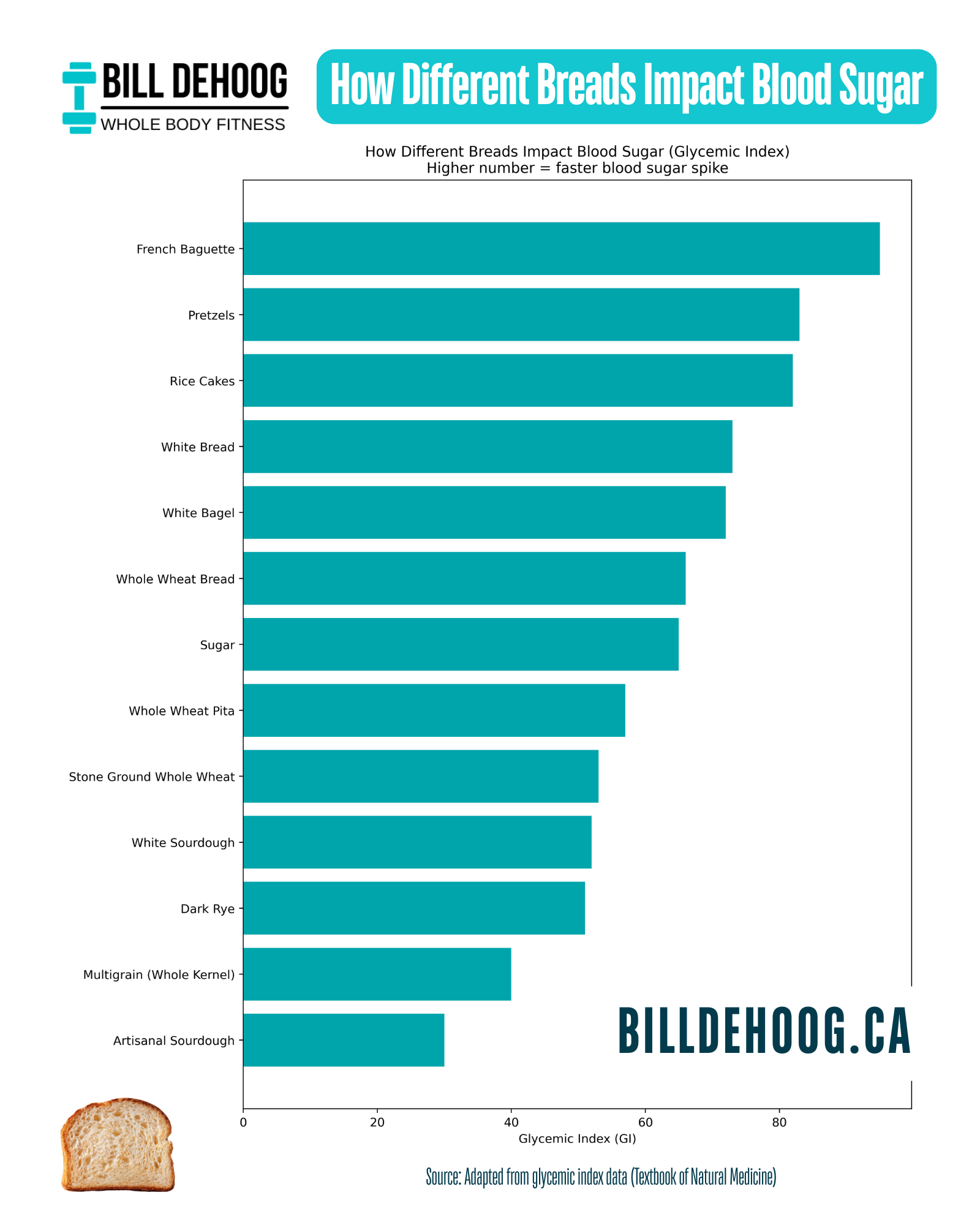
French baguette: very high glycemic response
White bread: rapid spike
Bagels and pretzels: similar effect
Even some “whole wheat” options: still fairly high
Meanwhile, true whole grains or fermented breads (like sourdough) tend to have a lower impact.
The key difference?
How quickly your body can break them down into glucose.
This Isn’t a Willpower Problem
One of the biggest mindset shifts Bill helps clients make is this:
Your system is reacting exactly as it should.
If your meals are creating sharp spikes and drops, your body will:
Ask for quick energy
Drive cravings
Make consistency harder
That’s not failure - that’s physiology!
What You Can Do Instead
You don’t need to eliminate bread completely.
But you do need to be more intentional with it.
Here’s where to start:
1. Pair Carbs With Protein & Fat
Instead of toast alone:
Add eggs, Greek yogurt, or nut butter
This slows digestion and reduces spikes.
2. Choose Lower Glycemic Options
Dense whole grain breads
Sourdough (especially traditional/fermented)
Multigrain with intact kernels
3. Watch Portion & Timing
Bread on its own = bigger spike
Bread within a balanced meal = more stable response
4. Pay Attention to How You Feel
After eating, ask:
Am I satisfied?
Or am I hungry again in an hour?
Your body will tell you what’s working.
The Bigger Picture
For many people, improving energy, reducing cravings, and supporting fat loss doesn’t start with cutting more calories.
It starts with stabilizing blood sugar.
When your body feels stable:
Cravings decrease
Energy improves
Consistency becomes easier
And that’s where real progress begins!
Final Thought
Sometimes the food that looks harmless…
…is the one quietly driving the cycle.
Not because you’re doing anything wrong.
But because no one ever explained what was happening.
Take Action
If you’ve been struggling with cravings, energy crashes, or consistency, you’re not alone.
Let’s build a plan that works with your body, not against it.
Reach out to get started with personalized nutrition and coaching with Bill DeHoog!