
What Your Bones Need as You Age
Have you taken the time to think about the health of your bones - and how they might impact you as you age?
Most people tend to think about one main thing related to bone health: calcium. But that’s not enough!
If maintaining strong bones as we age were simply a matter of drinking milk or taking a calcium supplement…osteoporosis and age-related bone loss would be much easier problems to solve.
Your bones are living, constantly changing tissue.
They’re continually being broken down and rebuilt, and their ability to remain strong depends on much more than one single mineral. Protein, vitamin D, other nutrients, muscle strength, physical activity, digestion, lifestyle and even your risk of falling can all become pieces of the bone-health puzzle.
Are you giving your body what it needs to maintain strong bones as you get older?
Let’s find out.
Your Bones Are Actually Quite…Lively
We tend to picture the skeleton as the body's permanent framework - hard, static and essentially unchanged once we're adults. That isn't actually what happens.
While bone may look solid and unchanging, it’s actually living, active tissue that’s constantly renewing itself.
Throughout our lives, our bodies carry out a process known as bone remodelling. Specialized cells break down older, weakened or damaged bone tissue, while other cells build new bone in its place. When we're younger, bone formation generally keeps pace with - or exceeds - bone breakdown. As we age, however, that balance can begin to shift, and we may gradually lose more bone than we're able to rebuild.
Aside from holding us upright, our skeletons protect vital organs, provide the framework that allows muscles to create movement, stores important minerals such as calcium and phosphorus, and contains bone marrow responsible for producing blood cells. In other words, bone isn't just the body's scaffolding - it's an active part of several essential systems.
Bone is built around a flexible protein framework composed largely of collagen. Minerals - particularly calcium and phosphate - are deposited within and around that framework, giving bone its hardness and ability to withstand force.
Think of it somewhat like reinforced concrete: the mineral component provides rigidity and strength, while the collagen-rich protein matrix provides an underlying framework and a degree of flexibility. Both contribute to a bone's ability to handle the stresses of everyday life.
Supporting bone health does involve calcium, but needs protein, vitamin D, other essential nutrients, and physical activity to maintain the body's ability to continually rebuild bone. It’s all part of the bigger picture - our whole-body health.
Bone Density Matters - but So Does Bone Quality
Bone mineral density is an important measurement used when assessing osteoporosis and fracture risk - but the strength of a bone also depends on its internal structure and quality as well.
As we grow older, the balance between bone formation and bone breakdown can shift.
Hormonal changes are one reason - the decline in estrogen associated with menopause, for example, can accelerate bone loss. Age, genetics, certain health conditions and some medications can also influence bone health.
Some of these factors aren't within our control.
Others are - which is why nutrition and exercise are so important.
Think of Bone Health as a Team, Not a Single Nutrient
Strong bones require several nutritional building blocks working together:
Calcium: the mineral we know
Calcium is a major structural component of bone - and getting enough throughout life is important.
Osteoporosis Canada currently recommends that calcium needs be met primarily through calcium-rich foods whenever possible.
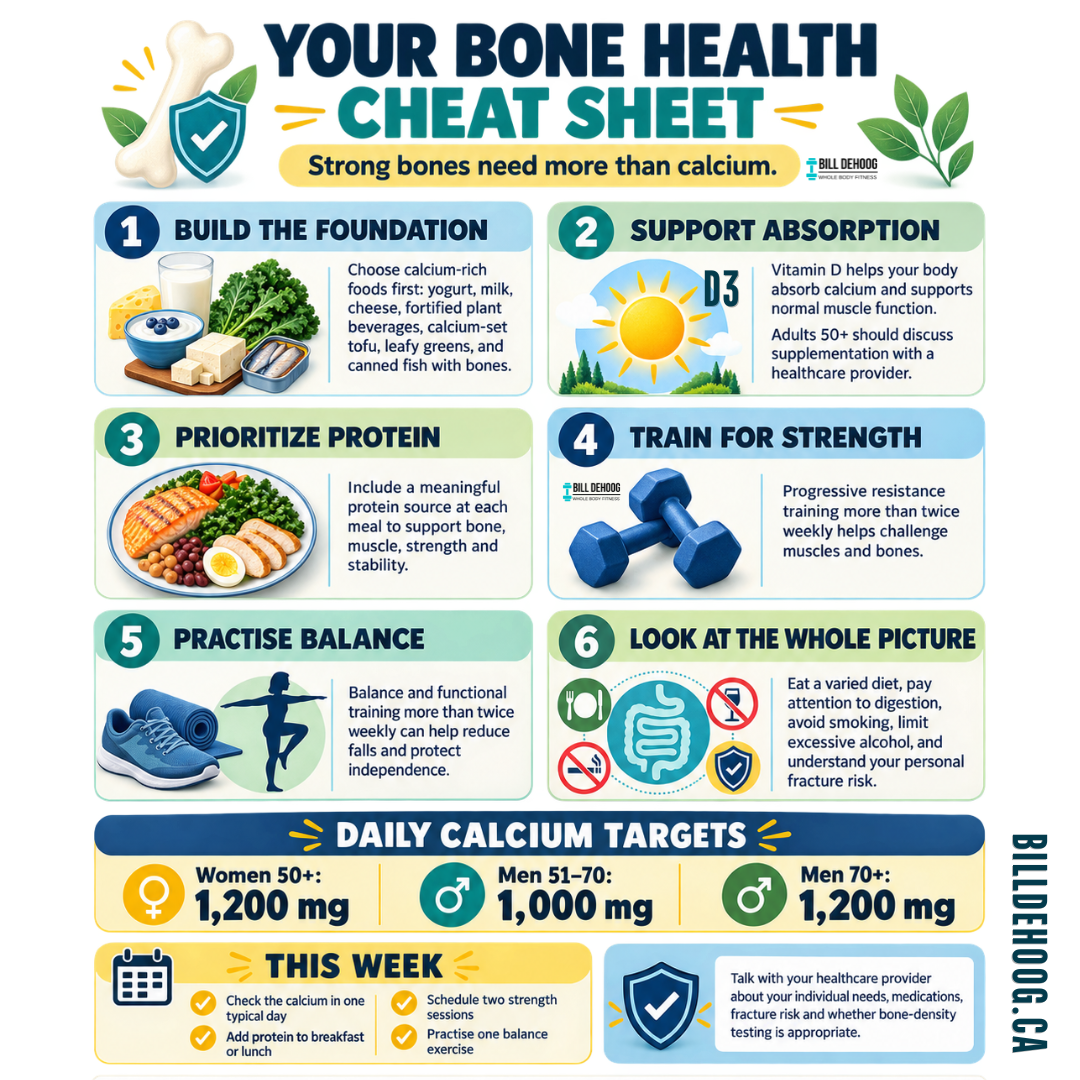
For adults over 50, recommended daily calcium intake varies by age and sex:
Women over 50: 1,200 mg per day
Men ages 51–70: 1,000 mg per day
Men over 70: 1,200 mg per day
Good sources can include yogurt, milk, cheese, calcium-fortified plant beverages, calcium-set tofu, canned salmon or sardines with bones, and certain leafy greens.
Instead of immediately reaching for a supplement, take a look at what you're actually eating.
You may be getting more - or considerably less - calcium than you think.
Vitamin D3: helping calcium do its job
Vitamin D3 assists calcium absorption and also contributes to normal muscle function - an important consideration because stronger muscles and better balance can reduce fall risk.
Osteoporosis Canada's current guideline points to Health Canada's recommendation that adults 50 and older take a minimum 400 IU vitamin D supplement daily, in addition to consuming vitamin-D-containing foods.
Individual needs can differ, so supplementation - particularly at higher doses - is something worth discussing with your healthcare provider.
Protein: an overlooked part of the skeleton
Your bones are 50% protein. Protein contributes to bone tissue and is essential for maintaining the muscles surrounding and supporting your skeleton. This becomes increasingly important with age.
If we lose muscle, we’ll also lose strength, stability and balance. That then increases the likelihood of falling - which means protecting your bones isn't simply about making the skeleton stronger, it's also about maintaining the body that protects it.
Try including a meaningful source of protein at each meal - such as eggs, Greek yogurt, cottage cheese, fish, poultry, lean meat, beans, lentils, tofu or another food appropriate for your diet.
Don't Forget Magnesium, Vitamin K and the Rest of Your Diet
Magnesium supports bone structure and helps with processes involved in calcium and vitamin D3 metabolism, while vitamin K helps activate proteins involved in building and maintaining bone. The bigger takeaway is that strong bones depend on a well-rounded supply of nutrients - not a collection of isolated supplements. A varied, nutrient-dense diet provides vitamins, minerals, protein, fibre and other beneficial compounds that work together throughout the body.
Easy inclusion tip: Add a handful of nuts or seeds, beans or lentils, and dark leafy greens such as spinach, kale or broccoli into your weekly routine. Small additions to meals can help broaden the range of bone-supporting nutrients you're getting naturally from food.
What Does Gut Health Have to Do With Your Bones?
Certain gastrointestinal diseases and conditions that interfere with nutrient absorption can contribute to poor bone health. Celiac disease, for example, can impair nutrient absorption and is a recognized risk factor for osteoporosis.
If you frequently experience unexplained digestive symptoms, major changes in appetite or difficulty maintaining a balanced diet, - it’s time to pay attention to what your body is trying to tell you.
Exercise May Be One of the Most Powerful Bone-Health Tools You Have
Bones respond to physical demand - and your muscles and bones work as a team.
Osteoporosis Canada's 2023 clinical practice guideline recommends balance and functional training more than twice per week and progressive resistance training more than twice weekly.
Resistance training involves exactly what Bill offers:
weights
resistance bands
body-weight exercises
progressive exercises that challenge the major muscle groups
Balance exercises are so important as they can help reduce falls, which is crucial later in life.
The bigger objective is preventing fractures and preserving independence!
Bone Health Isn't Only About What You Add
Sometimes it's also worth examining the habits that can work against you.
Smoking is associated with poorer bone health, while excessive alcohol consumption can also increase osteoporosis and fracture risk.
Sleep, physical activity and overall nutrition influence health and physical performance in many interconnected ways.
Consider the environment you're creating for your body every single day!
What About Plant-Based Diets?
A vegetarian or vegan diet does not automatically mean weak bones - but any restrictive eating pattern deserves a little more nutritional planning.
Someone eating primarily plant-based foods needs to ensure they're consistently getting adequate protein, calcium, vitamin D and other essential nutrients from appropriate foods, fortified products or supplements when necessary.
The most important question is:
Are your nutritional requirements actually being met?
Six Questions Worth Asking Yourself About Your Bones
As you get older, periodically check in with yourself.
1. Am I getting enough calcium from my regular diet?
Don't guess. Spend a day or two looking at the calcium content of the foods you actually eat.
2. Am I getting enough protein?
Look at every meal. If breakfast and lunch contain almost no meaningful protein, that's worth addressing.
3. Am I doing resistance training?
Walking is valuable, but maintaining muscle requires challenging it.
4. Am I working on my balance?
Balance is trainable - and it becomes increasingly valuable as we age.
5. Is something interfering with my nutrition?
Persistent digestive problems, an extremely limited diet or difficulty eating enough nutritious food deserves attention.
6. Do I know my personal osteoporosis and fracture risk?
Age, family history, previous fractures, medications and health conditions can change your risk. Talk to your physician or healthcare provider about whether bone mineral density testing or a formal fracture-risk assessment is appropriate.
The Goal Isn't Just Stronger Bones. It's a Stronger You.
Build muscle.
Challenge your balance.
Eat enough protein.
Get calcium-rich foods into your diet.
Pay attention to vitamin D.
Eat a varied, nutrient-dense diet.
Address persistent digestive or health problems instead of ignoring them.
And understand your personal risk factors.
There are things about aging we can't control - but there are also many things we can.
Focus on those.
Your bones - and the muscles that protect them - are counting on you!
Ready to build a healthier version of yourself?
Connect with Bill DeHoog for your free assessment and start your whole body health plan.